Use It or Lose It: Turning Leftover Budgets into Growth Pilots
Every fall, I see the same pattern in mid-sized businesses: unspent budgets quietly sitting in accounts, waiting to disappear before the year ends.
Jason Dyer
Thought Leadership
Article

Every fall, I see the same pattern in mid-sized businesses: unspent budgets quietly sitting in accounts, waiting to disappear before the year ends.
Someone inevitably says it:
"We need to use it or lose it."
It's not strategic, but it's real. Most teams rush to spend the money on low-impact purchases — a few new tools, a half-finished campaign, or one more event sponsorship. Then January hits, and those dollars are gone, along with the opportunity to create momentum.
But there's a better move.
Instead of "using" the budget to spend it, use it to grow.
Step 1: Host a "Never Got To It" Brainstorm
Gather your leadership team (or department heads) and ask a straightforward question:
"What projects did we always talk about but never seem to get to?"
You'll get a mix of answers — product improvements, customer experience fixes, marketing ideas, process automation, training, or data clean-ups. Capture everything without judgment.
💬 Tip: Keep it to 15 minutes and use a whiteboard or shared doc — the goal is momentum, not perfection.
Step 2: Plot Each Idea on a Simple 2x2 Grid
Once you have your list, plot each idea based on:
• Impact – How much could this move the business forward if it worked?
• Ease – How quickly and easily could we test it with the available budget and people?
You'll end up with four quadrants:
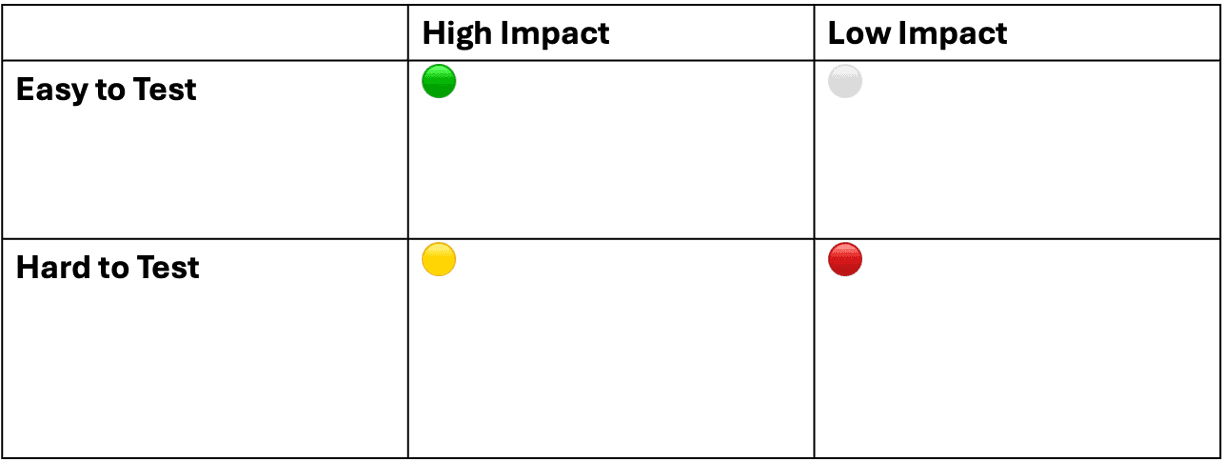
Circle the top one or two "Quick Wins" — something meaningful, measurable, and doable before year-end.
Step 3: Fund One Pilot Project Now
Use your remaining budget to fund that small experiment — not as a throwaway, but as an early start to next year's priorities.
Define it like a sprint:
• Goal: What specific outcome will we test or prove?
• Budget: What can we reasonably spend without over-planning?
• Owner: Who will drive it to completion?
• Measure: How will we know it worked?
Even a modest pilot can create a valuable case study, energize your team, and set the tone for your 2026 plan.
Step 4: Lock in the Narrative
When you roll into January, don't present it as "last year's leftovers." Present it as next year's launch pad.
You didn't just preserve budget — you built innovation. You didn't just spend money — you bought momentum.
That's how you turn a year-end scramble into a springboard for growth.
⚡ Final Thought
Research shows that organizations rushing to spend budgets at year-end often deliver lower-quality outcomes — especially when projects are started in the final weeks of the fiscal cycle[1][2].
The smarter move is to redirect leftover funds into small, testable innovation pilots that build learning velocity and position your team for faster growth next year[3][4].
So, this week, block off 45 minutes. Run your "never got to it" brainstorm. Pick your pilot.
And spring into 2026 already in motion.
📚 Footnotes/Resources
[1]: Liebman, Jeffrey B. & Mahoney, Neale (2017). Do Expiring Budgets Lead to Wasteful Year-End Spending? Evidence from Federal Procurement. Harvard Kennedy School / National Bureau of Economic Research (Working Paper 23090). →https://www.nber.org/papers/w1948 1
[2]: National Bureau of Economic Research Digest (2014). Use-It-or-Lose-It Budget Rules. NBER Digest, March 2014. Read digest → https://www.nber.org/digest/mar14/use-it-or-lose-it-budget-rules
[3]: We Are Outcome (2022). Making Metered Funding Work in a World of Annual Budgets. Advocates for flexible, pilot-based "metered funding" to improve innovation velocity. Read article →https://weareoutcome.co/blog/making-metered-funding-work-in-a-world-of-annual-budgets
[4]: The Chronicle of Philanthropy (2021). Turning Unspent Budgets Into Vital Resources. Shows how organizations can convert unspent funds into cross-functional pilot projects and faster learning cycles. Read article →https://sponsored.chronicle.com/turning-unspent-budgets-into-vital-resources


